Quantum Key Distribution (QKD) is one of the most promising approaches for achieving secure communication in the quantum era, as it enables the generation of shared cryptographic keys with security grounded in the laws of quantum mechanics. However, most QKD protocols are still designed for relatively static and controlled environments, making their deployment challenging in dynamic networks affected by topology changes, link failures, noise, and heterogeneous hardware capabilities.
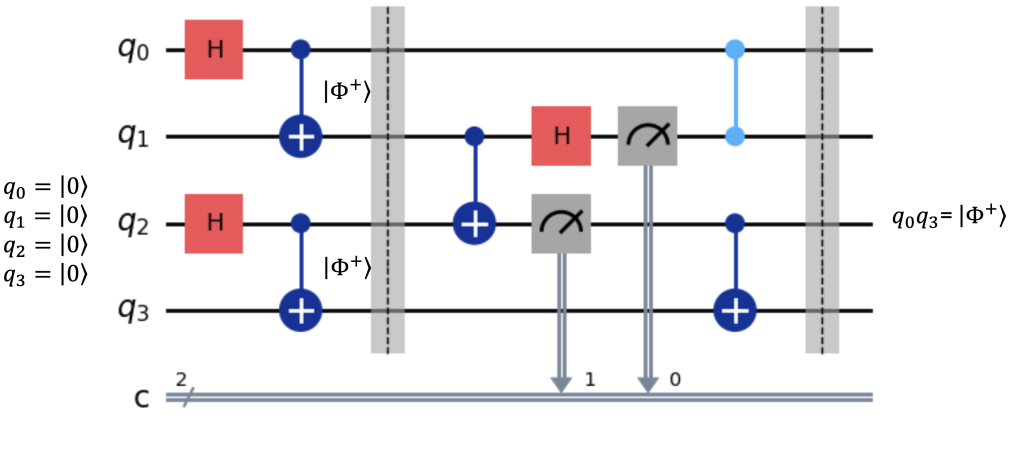
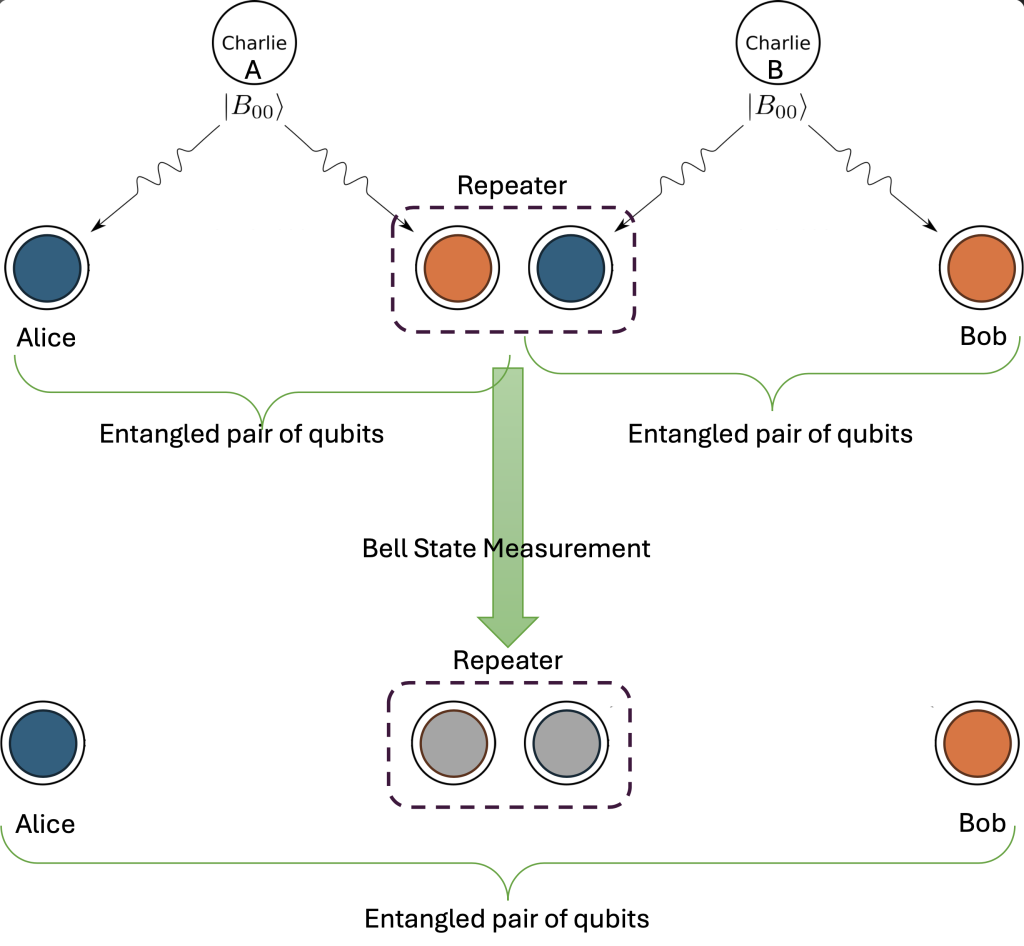
Our research is mainly focused on designing adaptive QKD mechanisms for dynamic quantum networks. In particular, we investigate how key distribution can be made more efficient and resilient through adaptive routing, entanglement recycling, fault-tolerant re-keying, and an SDN-inspired control layer. The goal is to support continuous and secure key generation even when network conditions change, improving scalability, resource usage, and robustness of future quantum communication infrastructures.
Read our work:
F. Cirillo, M.C. D’Aloia and C. Esposito, “Integrating Classical and Quantum PUF with QKD for Secure IoT Networks”
F. Cirillo, M.C. D’Aloia and C. Esposito, “QKD Authentication and BB84 Optimization Using QPUFs for the Quantum Internet”
F. Cirillo, M.C. D’Aloia and C. Esposito, “Priority-Aware Key Assignment for Exhaustion-Resilient QKD Key Management Systems”